
I’ve worked in digital marketing and content for a long time, so I know the routine. Create the post, write the caption, come up with the hook, make the Reel, repurpose it, check the analytics, and start over again tomorrow.
There’s nothing inherently wrong with that. But as I think about what I want to build next, I keep coming back to one question: Do I really want to create a business that needs me to keep showing up every day just to stay visible?
That’s a big reason Anti-Social SEO 2.0 makes sense to me. It’s built around a search-first approach — SEO, GEO, and AI visibility — for people who want to get found without making social media the center of the business.
For me, the answer is no. I want to build something useful and give it a real chance to make money. I also want enough room in my life to step away from the screen without feeling like the whole thing stops moving.
I’m not anti-social media
I still use social media, and I’ll continue using it. It can be useful for connection, credibility, and helping people discover what you do.
But I don’t want it to be the engine of my business. There’s a difference between using Instagram and needing Instagram.
If I take a week off, I don’t want everything to disappear. And if I spend time creating something genuinely useful, I want it to have a chance of helping someone next month or next year, not just for the next 24 hours.
That’s a big part of what I’m experimenting with here at Side Hustle Peace.
What I’m trying instead
The model I’m building looks more like this:
Useful content → search and Pinterest → email → thoughtful recommendations and offers
Social media can support that system, but it doesn’t have to carry it.
That’s also why I’m putting more energy into things with a longer shelf life. A blog post can keep getting found. An email subscriber is someone I can reach again. A useful free tool can continue bringing people deeper into the site, and a digital product can sell without me being online at the exact moment someone discovers it.
I wrote more about this in A Content Routine That Keeps Working After You Log Off because the idea is simple: create fewer things that have more chances to keep working.
Search is changing, too
For years, SEO mostly meant trying to rank in Google. That still counts for a lot, but search now has another layer.
People are also using ChatGPT, Perplexity, Gemini, Google’s AI Overviews, and other AI-powered tools to find answers, compare options, and decide what to buy. This is the idea behind GEO, or generative engine optimization.
GEO is not really a replacement for SEO. It’s about making your content clear, authoritative, well structured, and comprehensive enough to be useful not only in traditional search results, but also when AI systems assemble an answer from multiple sources.
One thing I found especially interesting is that ranking on page one no longer guarantees you’ll be cited by AI. Ahrefs analyzed millions of Google AI Overview URLs in 2026 and found that only about 38% of cited pages also appeared in the top 10 for the same query. In July 2025, that overlap was closer to 76%.
Kate Kordsmeier points to some other numbers on the Anti-Social SEO page that helped put the shift in perspective for me. A Previsible analysis reported by Search Engine Land found AI-referred sessions across 19 GA4 properties were up 527% when comparing January through May 2025 with the same period in 2024.
She also highlights BrightEdge research showing organic search accounted for about 53% of trackable website traffic, while organic social accounted for roughly 5%. That research is from 2019, so I wouldn’t treat it as a snapshot of traffic today, but it’s still a useful reminder that search was a major discovery channel long before AI entered the picture.
That overlap is one reason Anti-Social SEO 2.0 caught my attention.
AI can be useful on the creation side, too
There’s another side to this that I find appealing: AI isn’t only changing how people discover content. It can also reduce some of the work involved in creating and maintaining that content.
I don’t mean handing ChatGPT a topic and publishing whatever comes back. I still want the ideas, point of view, examples, and judgment to come from me.
Where AI gets interesting is in the support work. It can help map related questions around a topic, organize content clusters, identify gaps in an older post, suggest FAQs, structure information more clearly, repurpose a transcript or voice note, and help you see whether a piece answers the kinds of follow-up questions an AI search tool might generate.
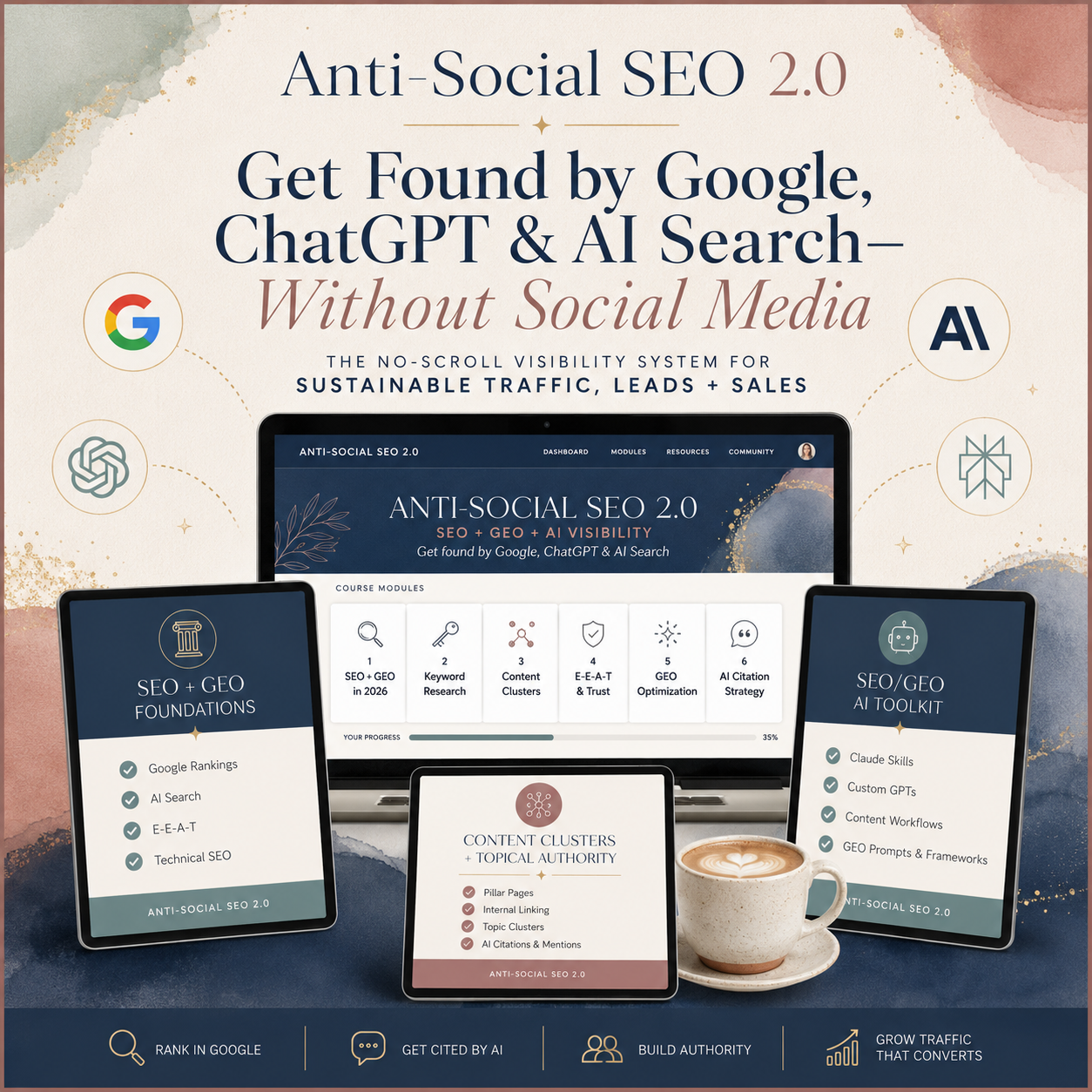
That’s a significant part of the rebuilt Anti-Social SEO 2.0 program. Kate’s current version includes an SEO/GEO Claude skill and custom GPT for drafting and auditing content, an AI editorial calendar for planning topical clusters, a Traffic Interpreter for making sense of search data, plus training around E-E-A-T, updating older content, schema, structured data, and other search fundamentals.
I like that combination better than treating AI as a shortcut for producing more content. Used well, it can help make the content you were already going to create more organized, useful, and easier to maintain.
Why Anti-Social SEO fits what I’m building
The name obviously got my attention, but the strategy behind it is what interested me. The idea is to create useful content people can find when they’re already looking for an answer, instead of relying primarily on interrupting them in a social feed.
That is much closer to the kind of marketing I want to do.
It also addresses one of my biggest frustrations with content marketing. I don’t mind creating content. I mind creating content that has almost no useful life after I publish it.
The appeal of search-based content is its potential to compound. A strong article can keep bringing in readers long after the week you published it.
That does not mean “write one blog post and collect passive income forever.” Search takes time, content needs strategy, older posts sometimes need updating, and the way people search keeps changing.
That actually makes the approach feel more realistic to me, not less.
I put the strategy through my own Peace Test
I recently built something called The Peace Test for Side Hustle Peace. It’s a simple framework for evaluating an idea based on the things that often get ignored when everyone is focused on income potential.
I look at questions like how much time something requires, how much maintenance it creates, how visible you have to be, whether the work can keep creating value later, and whether you would actually want to keep doing the work if the idea succeeds. Through that lens, a search-first strategy looks pretty good for me.
Time: Promising, with a caveat
Search is not instant traffic. There’s upfront work involved in creating useful content and learning how the process works.
The tradeoff is that the content can continue doing something after the initial effort. That suits me better than creating a fresh piece of content every time I want attention.
Maintenance: Lower, not zero
Evergreen does not mean abandoned. Articles need updates, search performance needs checking, and websites still need maintenance.
But I would rather update a valuable article periodically than feel pressure to manufacture something new every morning.
Visibility: Very good fit
This is probably the biggest one for me. A search-first model does not require me to make myself the product.
I can write, research, teach, test ideas, and create useful resources without being on camera every day to prove the business exists.
Compounding: Strong
This is the feature I care about most. I want the work I do today to have some chance of helping me tomorrow.
That’s true of blog posts, email lists, digital products, and other owned assets. Nothing is guaranteed, but at least the structure allows the work to build on itself.
Peace: Yes
This part is personal. Someone else may genuinely love daily social media creation.
I don’t, and I’ve reached the point where I think the business model needs to fit the person running it, not just the other way around.
Who I think should look at Anti-Social SEO
Anti-Social SEO makes the most sense to me if:
- You have or want a website that acts as your business home base
- You like the idea of creating useful, searchable content
- You’re tired of depending on social media for visibility
- You want to understand how AI search is changing content discovery
- You’re willing to give search time to work
- You want your content to become an asset rather than another daily obligation
I would be more cautious if:
- You need traffic immediately
- You don’t want to build and maintain a library of searchable content
- Social media is already working extremely well for you and you enjoy it
- You’re looking for something completely done for you
For me, the appeal is not that search eliminates the work. It changes the kind of work you are doing and gives some of that work a longer life.
What I’m doing with it
I’m not writing this from the finish line, and I want to be clear about that. Side Hustle Peace itself is part of my experiment.
I’m building the site, creating evergreen articles, growing an email list, testing Pinterest, building my own tools and digital products, and making selective affiliate recommendations. I’m paying attention to which pieces continue working when I’m doing something else.
That’s the part I plan to keep sharing: not just what someone says should work, but what happens when I actually try it.
So, can you grow a business without posting every day?
I think the better question is whether you can build a business that is not completely dependent on posting every day.
I believe you can. Search can be part of that. Email can be part of that. Evergreen content, digital products, partnerships, and social media can all work together without social media becoming the entire business model.
That’s the kind of business I’m interested in building now: one that has room for me to step away from the screen and still exist when I come back.
Frequently asked questions
Is GEO replacing SEO?
No. I think it makes more sense to see GEO as another layer of search optimization. Traditional SEO can help search engines understand and rank your content, while GEO focuses more specifically on making that content useful and citable when AI tools construct answers.
Kate describes the two as connected: strong SEO supports GEO, while newer tactics such as clear answer-first writing, stronger topical coverage, schema, FAQs, and trust signals can improve your chances of being surfaced by AI systems. Her rebuilt course teaches both together.
Do I have to abandon social media for this to work?
No. I’m not abandoning social media either.
For me, the goal is simply to stop making it the only way people can discover the business. Search, Pinterest, email, partnerships, and social media can all play a role without requiring you to post constantly.
What if I already have blog posts?
That may actually give you somewhere useful to start. Existing content can be updated, expanded, better structured, and optimized for newer search behavior rather than automatically starting from scratch.
The tools included with Anti-Social SEO 2.0 are specifically designed to audit and re-optimize previously published content as well as turn existing material such as transcripts and voice notes into search-focused posts.
What exactly is included in Anti-Social SEO 2.0?
The current program goes beyond a set of SEO videos. It includes 10 lessons plus a schema module, an SEO/GEO Claude skill and custom GPT, an AI editorial calendar, content-planning tools, a Traffic Interpreter, interactive checklists, and access to Kate’s community.
The topics include keyword research, pillar pages and content clusters, traffic analysis, E-E-A-T, updating old content, GEO, and structured data.
Can AI do the whole thing for me?
I wouldn’t approach it that way.
AI can help with research, organization, optimization, repurposing, content audits, FAQs, and identifying gaps. But the experience, opinions, examples, and expertise that make a piece worth reading still need to come from a real person — especially as more generic AI content gets published.
How long does search traffic take?
There isn’t a reliable universal timeline, and I would be wary of anyone promising one. SEO is usually a compounding strategy rather than an immediate traffic source.
That is also how Kate positions the program: it isn’t intended for someone expecting rankings in a matter of days or unwilling to keep publishing for a period of time.
Want to explore Anti-Social SEO?
If the search-first, social-media-light approach sounds like something you want to learn more about, you can take a look at Anti-Social SEO 2.0 from Success With Soul.
Affiliate link. I may earn a commission if you purchase through it, at no additional cost to you.
Not sure this strategy fits you?
Try The Peace Test. It’s free and helps you look at an opportunity based on your real time, budget, energy, tolerance for maintenance, and the kind of work you actually want to do.
Want help getting started?
Kate at Success With Soul runs a free four-day challenge called Beyond the Scroll. It covers growing a business without social media: simple SEO, getting found, and selling without the pushy part.
Join the free Beyond the Scroll challenge
Affiliate link. I may earn a commission if you buy something later.
Want to follow the experiment?
Side Hustle Peace Notes is where I share what I’m testing, what I’m learning, useful resources, online-business news worth paying attention to, and occasional offers I think are worth considering.