
You want to make extra money. You have a few hours a week, skills you could put to work, and enough motivation to try something new.
Posting on Instagram every day, filming TikToks, or turning your personal life into content? You'd rather pass.
You can make money without social media. Freelance services, digital products, pet sitting, and event rentals are just a few ways to find paying customers without building an online following.
Choosing something that fits your skills, schedule, and comfort level comes first. Then you need a way to reach the people who actually need it.
Here are 11 online and offline side hustles, what each involves, and how to get started.
Can you really make money without social media?
Yes. You can make money without social media by selling a service, product, or skill through referrals, search engines, local partnerships, marketplaces, or direct outreach.
Social media is one way to reach customers. It isn't the only way.
A freelance writer might find clients through referrals and targeted emails. A yoga instructor can teach at a local studio. A pet sitter might build a client base through neighborhood recommendations. Someone selling a digital product could attract customers through Google or Pinterest.
These approaches still require marketing, but a daily posting schedule doesn't have to be part of the job.
6 online side hustles that don't require a social media following
These six options let you work from home, though client deadlines and scheduled sessions still need a place in your week.
1. Freelance writing or editing
Strong writing skills can translate into blog writing, website copy, email marketing, editing, or proofreading services.
Businesses hire writers to explain what they do, reach customers, and make their content easier to read. Your follower count has little to do with delivering that work.
I've worked as a freelance writer and editor for years, and I can tell you there's a lot more to the job than writing pretty sentences. Client relationships, deadlines, revisions, and finding the next assignment are all part of the business.
Working with skills you've already developed also means you can spend less time learning a new trade before taking on your first assignment.
How to get started: Choose one type of client or service. Create a few samples, put together a simple portfolio, and start reaching out to businesses that could use your help.
How to find clients without social media: Referrals, direct outreach, professional contacts, and searchable freelance service listings.
Best for: People with strong writing skills who prefer client work to building an audience.
2. Virtual assistant services
Many small business owners need help managing inboxes, scheduling appointments, updating websites, organizing documents, or handling other administrative tasks.
Organization, attention to detail, and confidence with everyday business tools matter more here than a public profile.
How to get started: Pick two or three services you can confidently deliver. Create a simple services page and offer a small starter package.
How to find clients: Business referrals, targeted outreach, professional networks, and freelance marketplaces.
Best for: Organized people who enjoy supporting businesses behind the scenes.
Some clients expect availability during business hours. A full-time job may leave more room for project-based assignments than inbox monitoring throughout the day.
3. Create and sell digital products
Digital products can include templates, planners, checklists, spreadsheets, workbooks, and guides.
You create the product once, then sell copies without shipping physical inventory.
The appeal is obvious: no packing boxes or trips to the post office. Finding buyers and keeping the product up to date are still part of the work.
How to get started: Identify one specific problem people regularly encounter. Create a small product that helps solve it, then test whether anyone wants to buy it before developing a larger product line.
How to find buyers: Search-optimized blog posts, Pinterest, email marketing, and marketplaces where customers already search for solutions.
Best for: People who enjoy creating tools, organizing information, or turning specialized knowledge into useful resources.
Start small. One spreadsheet that solves an annoying problem can be a better first experiment than a complicated course.
Thinking about creating your first digital product?
One thing I've learned from experimenting with digital products is that coming up with an idea is usually the fun part. Figuring out what to include, how to price it, and how to get it in front of buyers takes a little more thought.
If you'd rather follow a structured process than figure out every step on your own, Digital Product Launch Formula is an option to look into before building your first offer.
Affiliate disclosure: I may earn a commission if you purchase through this link, at no additional cost to you.
4. Offer website design or maintenance
Small businesses often need help building, updating, and maintaining their websites.
Depending on your skills, you could handle website builds, landing pages, updates, or ongoing content maintenance. You don't have to offer custom development to help with those jobs.
I've worked on websites as part of my own business, and one thing I've learned is that clients often value someone who can make the whole process feel manageable.
How to get started: Choose a website platform you know well. Build a sample project and define a service you can deliver consistently.
How to find clients: Local business outreach, referrals, partnerships with designers or marketers, and your own website.
Best for: People who are comfortable with website tools and enjoy a mix of creative and technical work.
Maintenance work can lead to recurring client relationships. Be clear about response times and availability before a routine update turns into an expectation that you're always on call.
5. Sell educational resources or templates
Think worksheets for teachers, resources for yoga instructors, training materials for small businesses, or templates for people working in a specific profession.
Knowing the audience's day-to-day problems gives you a starting point for deciding what belongs in the resource.
How to get started: Think about something you've created for yourself that others in your field might find useful. Could you turn it into a professional-looking resource?
How to find buyers: Niche marketplaces, Google Search, professional referrals, and relevant educational websites.
Best for: People with specialized knowledge or experience.
Check ownership rights before selling anything developed for an employer or client. And if you use licensed templates or PLR content, confirm that the license permits your intended use.
6. Offer online tutoring or lessons
You can teach academic subjects, software skills, languages, music, or other topics through virtual sessions.
Live lessons let you start with one subject and adjust to what students need, without recording an entire course first.
The U.S. Bureau of Labor Statistics projects about 34,200 openings for tutors each year, on average, from 2025 to 2035. Most are expected to replace workers who change occupations or leave the workforce.
Those national figures don't guarantee demand for private lessons in your subject. Local referrals and conversations with potential students will tell you more about your own market.
How to get started: Choose one subject and one audience. Define the type and length of lessons you'll offer, then find a few potential students.
How to find students: Tutoring directories, referrals, local community connections, and educational partnerships.
Best for: People who enjoy teaching and working directly with others.
Some tutoring platforms or subjects may require credentials, background checks, or other qualifications.
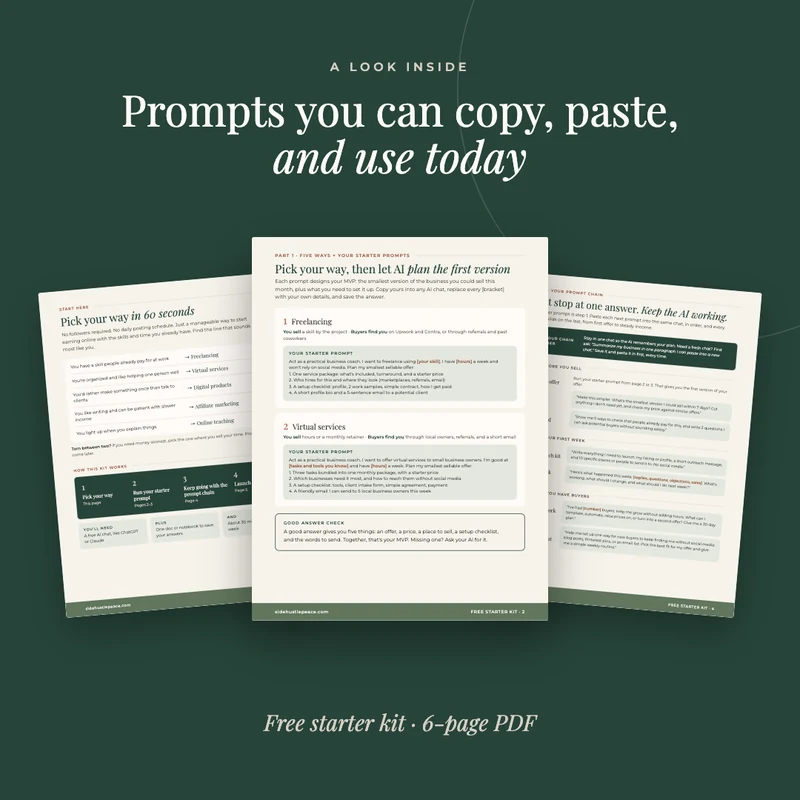
Want to try one of these ideas?
I put together a free starter kit for people who want to earn money online without building a social media following. It includes five income ideas, AI prompts to help plan your first offer, and a seven-day action plan.
5 offline side hustles that don't require social media
Not every side hustle needs a laptop.
Working offline can suit people who enjoy face-to-face contact, want a reason to get out of the house, or prefer a job with a clear beginning and end.
7. Teach fitness, yoga, or another skill
Teaching yoga has been part of my working life for years, and it's a good example of an income stream that doesn't require a social media following.
Studios, gyms, community centers, and private clients all offer possible routes into teaching.
You could also teach art, cooking, music, or other skills you know well.
The U.S. Bureau of Labor Statistics projects employment of fitness trainers and instructors to grow 7% from 2025 to 2035.
Industry growth doesn't tell you what an individual instructor will earn. Class rates, location, training requirements, and the number of classes you can realistically take on all matter.
And speaking from experience, teaching a one-hour class rarely takes just one hour of your day. There's preparation, travel, and sometimes laundry. So much laundry.
How to get started: Research the training or credentials expected in your field. Look for local studios, businesses, or organizations that hire instructors.
How to find clients: Studio employment, word of mouth, community partnerships, local search, and referrals.
Best for: People who enjoy teaching and in-person interaction.
8. Pet sitting or dog walking
Pet sitting or dog walking keeps the work close to home and puts time with animals at the center of your day.
As someone who shares her home with Max, my dog, and Holly, my cat, I understand why people want someone dependable looking after their pets.
Max would probably insist that walks and snacks are the most important qualifications. Holly would prefer that everyone simply follow her instructions.
The responsibility goes well beyond walks and snacks, of course. Pet owners are trusting you with members of their family.
The Bureau of Labor Statistics projects employment of animal care and service workers to grow 11% from 2025 to 2035. This occupation group is broader than pet sitting alone.
How to get started: Decide which services you're comfortable providing, research local requirements and insurance options, and establish a clear schedule and service area.
How to find clients: Referrals, neighborhood recommendations, local search, and pet-care marketplaces.
Best for: Reliable animal lovers who can commit to scheduled visits.
Consider travel time, safety, animal behavior, and holiday availability before accepting bookings.
9. Home organizing
Some people love organizing closets, pantries, paperwork, and storage spaces. Others would happily pay someone to help.
Home organizing combines that knack for putting things in order with hands-on work in someone else's space.
How to get started: Choose a manageable service, such as pantry organizing or closet resets. Practice documenting your process and create a simple package.
How to find clients: Referrals, partnerships with real estate professionals, neighborhood directories, and local search.
Best for: Detail-oriented people who like hands-on work and visible results.
Travel, supplies, physical demands, and the time each project takes all belong in your estimate — not just the hours spent organizing.
10. Event rentals
Small event rental businesses can offer items such as vintage audio guestbooks, photo backdrops, yard games, or party decor.
Instead of providing an hourly service, you're renting out equipment customers can use for a wedding, birthday, or other celebration.
It's a business model I've been interested in exploring myself.
How to get started: Research demand in your area before buying equipment. Estimate the full cost of purchase, storage, cleaning, transportation, setup, maintenance, and insurance.
How to find customers: Wedding vendor directories, event planners, venue partnerships, Google Business Profile where eligible, and referrals.
Best for: People who enjoy events, have storage space, and don't mind weekend commitments.
Rentals can look low-maintenance from the outside. Damaged equipment, transportation, and last-minute customer needs can quickly fill a weekend.
11. Local freelance services
This category includes services such as personal assistance, event support, household help, or other work you can provide in your community.
Start by defining a service people can understand and that you can deliver reliably. A narrow offer is easier to explain, price, and test.
How to get started: Identify a service you can deliver reliably. Research local rules, define your pricing, and test demand with a small number of clients.
How to find customers: Neighborhood referrals, local directories, community connections, and partnerships with businesses that serve similar customers.
Best for: People who prefer hands-on work and want to build relationships close to home.
Be specific about what you offer. "Personal assistance for busy households" is easier to understand than simply advertising that you can help with anything.
Which side hustle is right for you?
A business that looks easy to one person could exhaust someone else. Even a promising income model can ask for more time, money, or stress than you're prepared to take on.
Here's a quick comparison.
| Side hustle | Work style | Typical startup investment | Main consideration |
|---|---|---|---|
| Freelance writing | Remote, client-based | Low | Finding clients and managing deadlines |
| Virtual assistance | Remote, client-based | Low | Client availability |
| Digital products | Online, product-based | Low to moderate | Finding buyers |
| Website services | Remote or hybrid | Low to moderate | Technical support and revisions |
| Educational resources | Online, product-based | Low | Demand and licensing |
| Online tutoring | Remote, scheduled | Low | Scheduling and qualifications |
| Teaching fitness or yoga | In person, scheduled | Moderate to higher | Training, travel, and preparation |
| Pet sitting | Local, scheduled | Low to moderate | Insurance, safety, and reliability |
| Home organizing | Local, project-based | Low to moderate | Physical work and travel |
| Event rentals | Local, event-based | Moderate to higher | Equipment, logistics, and insurance |
| Local freelance services | Local, client-based | Low to moderate | Clear scope and repeat customers |
Startup investment categories are general comparisons, not fixed dollar estimates. Actual costs depend on your location, existing skills, equipment, insurance, licensing, and business model.
Before you choose, ask yourself:
- How much time do I actually have? Not how much time you wish you had.
- Do I want to work with clients or sell something I've created?
- Would I rather work online, in person, or both?
- What am I willing to invest before earning my first dollar?
- Would I still want to do this six months from now?
That last question is easy to overlook.
Six months of doing the work is a different prospect from an afternoon spent researching it. Think about the ordinary weeks, not just the launch.
How to find customers without social media
Choosing a side hustle is only half the work. You also need a way to reach customers.
Use referrals and existing relationships
If you're offering a service, start with people who already know your work.
Former colleagues, business contacts, friends, and existing clients may be able to make introductions.
Be clear about what you offer and who you can help. A specific request is usually easier to pass along than a vague announcement that you're starting a business.
Get found through Google
A website with clear service descriptions gives potential customers somewhere to check what you offer and how to contact you.
For eligible local businesses, a Google Business Profile may also help customers discover your services.
For digital products and online services, articles that answer specific customer questions can bring readers to your website through search.
That's the appeal of evergreen marketing to me. An article can keep helping readers find your work long after the day you publish it.
It takes time and effort, and results aren't guaranteed. But it gives your content a purpose beyond filling a social media feed.
Use Pinterest as a discovery channel
Pinterest is technically a social platform, but people also use it to search for ideas, resources, and solutions.
That can suit templates, educational resources, and articles people want to save and return to.
You can create pins that lead to helpful articles, tutorials, or product pages rather than relying on personal updates.
It's not the right fit for every business. Someone offering local dog walks may get better results from referrals and local search.
Build an email list
If you're creating content or selling products, email gives interested readers a way to stay connected.
A signup form, a welcome email, and occasional relevant updates give you a place to begin without setting up an elaborate funnel.
Send something readers have a reason to open, and give them time to get to know your work.
Try direct outreach and partnerships
A freelance editor could introduce herself to agencies. An event rental business could build relationships with wedding planners. A yoga instructor could contact studios or community centers.
Match your outreach to the service you're offering and the people who already have a reason to need it.
Related reading: How to Grow a Business Without Social Media.
A resource for growing without constant posting
If you're interested in using search to bring people to your website, Anti-Social SEO 2026 is a resource worth exploring. It focuses on building visibility through search rather than relying on a constant stream of social media posts.
Disclosure: I may earn a commission if you purchase through this link, at no additional cost to you.
A simple way to get started this week
Testing an idea can happen before you launch a website, buy equipment, create five offers, or set up an email sequence.
Try this instead:
- Day 1: Choose one idea. Pick the option that fits your skills, available time, and budget.
- Day 2: Define one offer. What exactly would someone pay you for?
- Day 3: Identify potential customers. Who has this problem, and where do they already look for help?
- Day 4: Research the practical requirements. Check startup costs, equipment, licenses, insurance, and other obligations that might apply. The U.S. Small Business Administration is a useful starting point.
- Day 5: Test interest. Talk to potential customers, request feedback, or share a clearly defined offer with an appropriate audience.
You might discover that the idea needs adjusting. Better to learn that from a few conversations than after spending money on something nobody wants.
Keep the first test small enough that you can learn from it without disrupting the rest of your life.
Start with work you can deliver
Making money without social media starts with work you can do and a way for customers to find it.
That might mean using skills you've developed over a career, helping people in your community, teaching something you love, or creating a product that solves a problem.
An audience can come later if it serves the business. For some of these ideas, referrals and a few repeat customers may be a better use of your time.
I'd pay as much attention to the ordinary working week as the income potential. The evenings, weekend bookings, and maintenance all count.
Choose something you can make room for without giving up every bit of room you have.
Not sure which direction fits?
Take the free Side Hustle Peace Test. It's a simple way to think through your strengths, priorities, and what kind of side hustle might work for you.
Start there. You don't have to figure out the whole business today.
Frequently asked questions
Can you make money online without social media?
Yes. Freelance writing, virtual assistant services, website services, online tutoring, and digital products can all generate income without requiring a social media following. You still need a way to find clients or buyers, such as referrals, search engines, marketplaces, or direct outreach.
What is the easiest side hustle to start without followers?
A service based on skills you already have is often one of the simplest options to test. You may be able to start by offering writing, editing, administrative support, tutoring, or another familiar service without purchasing inventory. The easiest choice depends on your experience and access to potential customers.
Are offline side hustles better than online ones?
Neither is automatically better. Offline side hustles may help you find local customers and build personal relationships, while online work may offer more flexibility or a wider customer base. Compare scheduling, startup costs, physical demands, and how you'll attract customers before choosing.
Can a side hustle succeed without marketing?
Usually, no. Even a referral-based business needs people to know it exists. The good news is that marketing doesn't have to mean posting every day. Referrals, partnerships, Google Search, directories, email, and direct outreach can all help connect a business with customers.